The Blue Dot Spins, the Signal Drops, and You Are Lost
You had a street in mind. Then the plaza that should have sat one block from the hotel is a parking deck, the signs are almost readable, and the blue dot on your phone sits in a gray grid with no names. A dream about being lost keeps the body moving after the link between this block and the next has failed. Once the errand drops away, what you want is usually smaller than the city: one door that still means home.
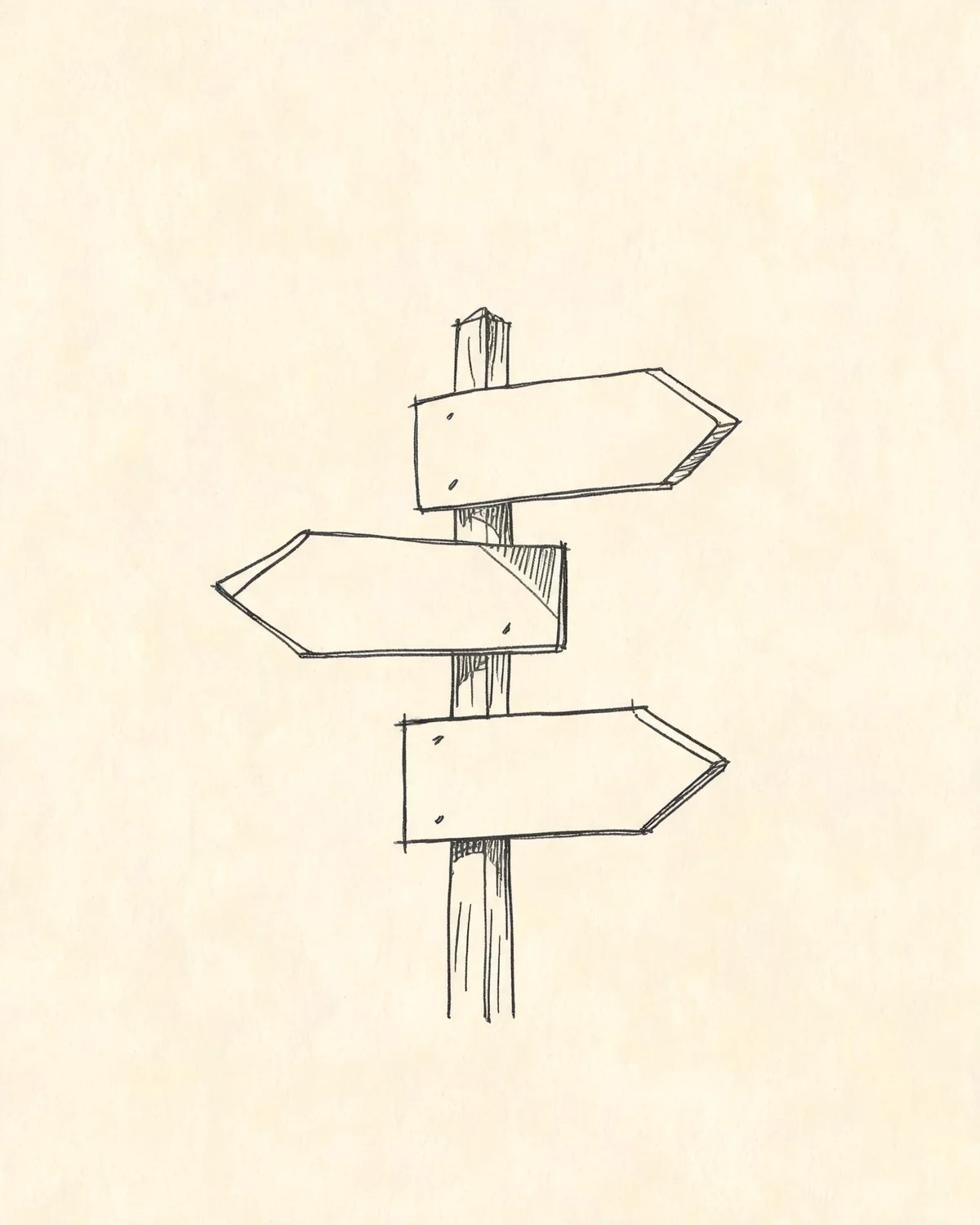
What It Means When You Dream of Getting Lost
Getting lost is orientation failing while the walk continues. The pavement is ordinary. What goes is the relation between where you are and where you meant to be. That gap is the subject. A plan, a role, or a bond has grown a bend you did not budget for, and the landmarks you used — a job, a friend's advice, a habit — have stopped pointing the same way.
The effort can matter as much as the error. These dreams often include a correction that worsens the position: another turn, a stranger whose directions evaporate as soon as you pull away, a freeway ramp that should have reset the journey and instead aims you at a town you have no name for. Attention locked on the route you already chose is what hides the wider place.
Home, when it takes over, is less an address than the feeling of knowing what you prefer. The meeting fades. The only wish left is to get back to whatever would make the next choice obvious: a person, a house, a conviction that still holds when the neighborhood does not. A labyrinth can hold a similar confusion, but its paths are built to puzzle you. These streets were supposed to be ordinary, which is why their failure feels personal.
Why This Dream Shows Up Now
The dream tends to arrive when a decision has more options than landmarks. A move, a new workplace, a city whose rules you have not learned, a friendship or a faith that used to settle questions and has gone quiet. Sleep builds a grid where every block is almost the right one.
It also arrives when you have been solving by speed. Another tab, another opinion, a route that ought to rejoin the old road. The circles in the dream match a mind that stays in motion because stopping would mean the original heading was off.
Sometimes the week was only a string of small misses — a conversation that left the point, a task restarted three times — and the night stacks them into one city.
How the Meaning Changes
The kind of place, the state of any guide you carried, and whether home has replaced the errand change the reading.
Lost in a city you have never seen
Foreign signs, a station with too many exits, a hotel name you cannot quite recall. The confusion matches a life that is actually new. Shame about asking, and the person you expected to meet, tell you more than the skyline.
Lost where you used to know the way
The bakery has changed corners. Your own street has grown an extra block. This version stings because the map was yours. A house, a job, or a relationship has been redrawn while you kept walking last year's directions. The map in your head is loyal. The ground is not.
The way home will not appear
The errand is gone. Every instruction contradicts the one before it, and the only goal left is the door you started from. If the blocks turn rough — fewer lights, no one you would stop — confusion has picked up danger. Other people's suggestions become noise. Underneath is a wish to feel safe enough to choose, which may have little to do with the task you left to do.
The phone map goes dark
A spinning wheel, a dropped signal, a route that redraws itself into a river. You had handed the steering to a tool, and the tool quit. What remains is whether you can name one landmark with the screen black. Outsourced judgment is the habit under the glass: moving only when an app agrees.
How Cultures Have Read This Dream
Older path-symbols already split this feeling. One kind of maze is a single winding line. You may be exhausted, and you still cannot take a wrong turn, because there is no fork. The other kind is built of dead ends and needs a key you do not have. Being lost on city streets belongs with the second. Choices are everywhere, and none of them is labeled.
Some traditions are oddly kind to a person of learning who loses the way: the teaching will travel farther than the feet. On a highway that runs straight and still loses you, the same image is read as a drift off the road you meant to keep. A twisted road can mean the opposite errand, a search for the way out of a mistake. Finding the path afterward is read as taking a correction when it is finally offered.
Making Sense of It for Yourself
Name the place before you name a moral. A city you have never seen, a neighborhood you could once have drawn, a highway, a parking deck, a station: each one says whether you are new or whether an old map has gone stale.
Then recover the original destination, if it lasted. When it vanished and only home remained, the night was about orientation itself. When you still knew the address and could not arrive, it was about the route, including the people whose directions you took and immediately lost.
After waking, write the last landmark you trusted, in the dream or in the week, and decide whether you will still steer by it. If someone was with you, note whether their help shortened the circle or lengthened it. You do not owe the whole city a solution before breakfast. You owe one turn an honest no.
Religious and cultural readings
Islamic and Christian dream interpretation each have their own reading of this image.
FAQ
What does a dream about being lost usually come down to?
It usually comes down to a plan that no longer matches the ground. The streets stay ordinary while the link between this block and your aim fails. Panic, shame, or a strange calm weights the reading more than the skyline does.
What if I got lost inside a school or a hospital?
Those buildings run on rules, bells, and corridors that repeat. The confusion is institutional: you have a private errand inside a public layout, and the people in uniform will not pause for it. Student, patient, or parent in a waiting room are all enough to stage it.
I was lost with someone else. Does the company matter?
A companion who knows the way, one who is equally lost, and one whose advice you resent are three dreams. Shared confusion can be closeness. Resented directions can be the week you have already been having with that person, drawn as streets.
Does getting lost mean I am failing a real decision?
It means a decision currently has poor landmarks. Look at whether you were willing to stop, ask, or admit the heading was off. Those are the moves the night kept refusing or allowing, and they travel better than a verdict on your competence.
Why did I wake the second a landmark appeared?
Recognition is a small resolution. Sleep often breaks at the click of knowing a corner, the way it breaks from a fall at the moment of landing. The shop, the voice, or the street that returned is the kind of anchor you are short of.