You Saw the Tsunami Coming. What Did Your Legs Do?
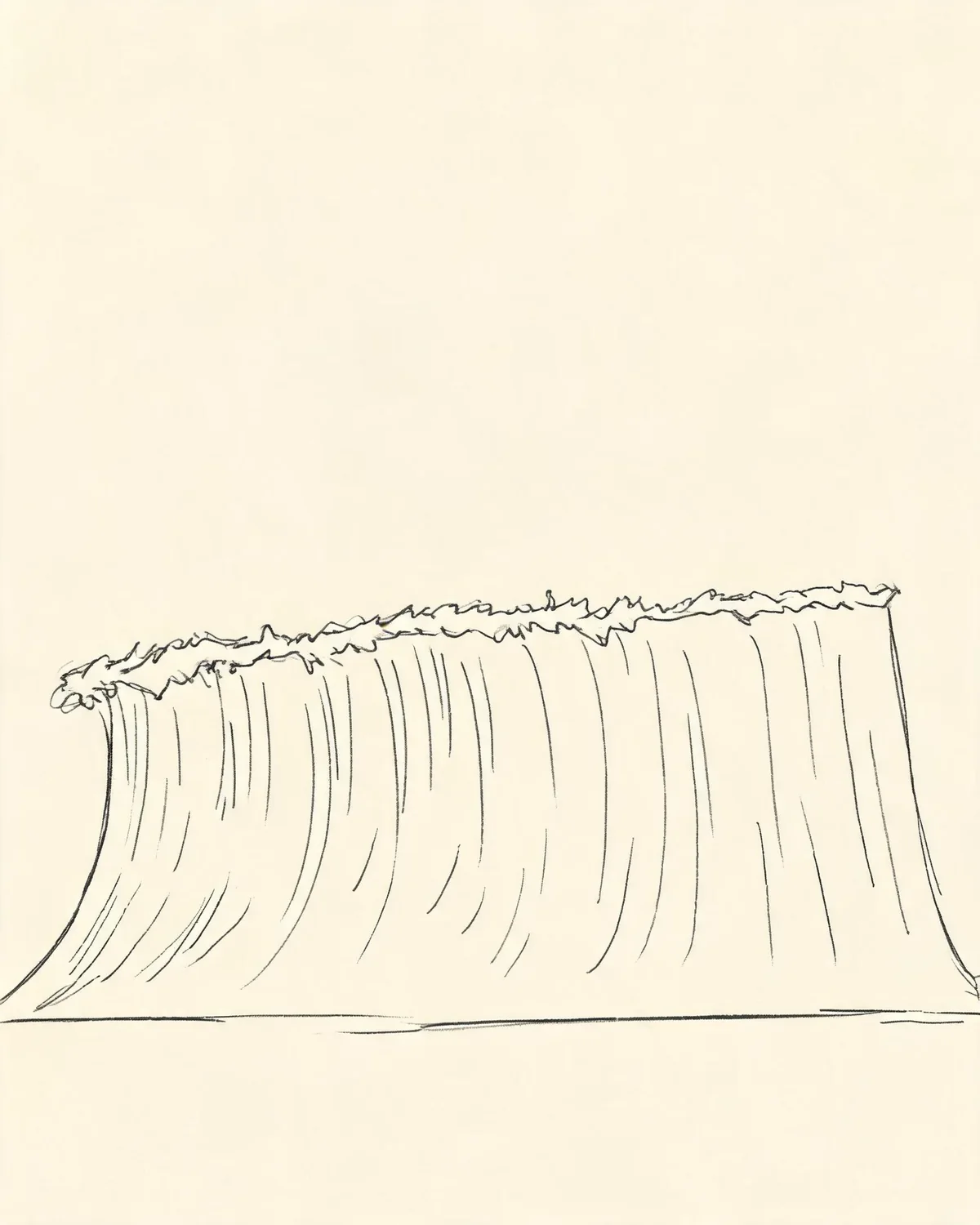
The sea is flat, and then it is not. A dark line lifts beyond the last hotel, taller than the buildings, and it does not break the way a beach wave breaks. It advances as a wall. A dream about tsunami is built on that mismatch of scale and time: the water is already too large, and the street between you and higher ground is already too long. The feeling is less "storm" than "this will arrive before I can finish a thought."
What It Means When You Dream of a Tsunami
A tsunami in a dream is emotion, or a change, arriving in a single mass. Ordinary waves come in sets and leave a shore behind them. This image refuses the rhythm. One wall, seen from too far away to bargain with, stands in for a feeling or a turn in life that has outgrown the channels you were using.
A marriage ending, a loss close to home, a job that finishes in a week, a truth you have been stepping around: the waking event does not need to look like water. It needs to feel larger than your next move.
The sea is the strange part. On other nights it carries and feeds. Here it has turned. Something that used to hold you up — a marriage, a belief, a workplace — becomes the thing you have to flee. Nourishment and threat are one substance, which is why the dream feels like betrayal as well as danger.
Nothing in the wall is a forecast of a wave on a real coast. You are already inside the situation the water is picturing, or you are afraid you soon will be. Denying the size of it, in the dream and after, tends to freeze the legs. The image is blunt about timing: the overwhelming part is current, and it will not stay at this height forever.
Why This Dream Shows Up Now
These dreams show up when a change has stopped being theoretical. The papers are filed, the conversation has been had, the family news is no longer a rumor you can postpone. Sleep reaches for the largest moving thing it knows and puts you on a beach road with bad shoes.
They also show up when you have been competent at not feeling the size of something. Work continues. Meals continue. The dream cancels that competence in one glance at the horizon.
Sometimes the prompt is only scale itself. A film, a coast you just left, a week of headlines. Sleep still chooses you for a reason of its own: something you cannot outrun by walking faster.
How the Meaning Changes
Distance, shelter, and whether you are alone change a single wall of water into several dreams.
A line of water on the horizon
You see it before it reaches anyone. The dread is anticipatory, and the scene still contains a little time, which the dream may spend on argument: pack, or watch, or insist it will break offshore. This version often belongs to a change you have already spotted and have not started to meet. The water's distance is the time you still have, and are using to debate the obvious.
No time to reach high ground
The street is too long, the car will not start, a child or a bag is still in the building. The subject is lateness of the inner kind. You knew, and the knowing did not become movement. People who are caring for someone else often get this variant: the body that must be saved is not only theirs, and the seconds are cruel about that.
Watching from a high window
You are indoors with others, and the glass shows a wave bigger than the block. Paralysis replaces running. A private overwhelm has an audience, or you find that the people with you are equally stuck. The ocean is no longer a view. It is coming through the view.
You wake as the water arrives
Contact and consciousness trade places. The dream spends its force on the approach and withholds the aftermath, which often means the feeling is still larger than any story of what comes after. Waking hands the rest to the day.
How Cultures Have Read This Dream
A great water, in stories told far apart, closes one cycle and opens another. Shapes smash. The force in the water is still expected to bring life back in a form the old shapes could not hold. A tsunami dream can borrow that reset and still say nothing about your coastline.
Other readings stay with motion itself: unrest, shifting fortune, a life that will not hold still. Foam and the dark body of a wave have even been given opposite tones, purity beside power. Some traditions add a local note: harm on the way, or a town overtaken, and praise for the person who fights water at a door to keep a household intact. A tsunami rarely offers the useful aftermath. It offers the approach, the insufficient road, and the size of what is coming.
Making Sense of It for Yourself
Separate the wave from the rest of the clip. Where were you when you first saw it, who else was in the frame, and what did your legs actually do? Running, freezing, grabbing a person, and going upstairs are different reports on agency. The water's height is the volume of the feeling. Your feet are the policy.
Then locate the waking mass that has no good road off it. If you cannot name one, the night may be rehearsing scale itself, the fear of being small against something impersonal. If you can name one, give that situation twenty undistracted minutes.
Write down the first thing your legs did, in one verb. That verb is a better souvenir than the height of the wave. It is the part of the night you can practice differently tomorrow.
Religious and cultural readings
Islamic and Christian dream interpretation read this image through a closely related one.
FAQ
What does a dream about tsunami tend to be made of?
A single mass of water, seen too late to negotiate with. It usually stands in for a feeling or a life change that has outgrown the ways you normally carry things. Scale and the shortage of time matter more than seawater itself.
How is this different from a flood dream?
A flood is water that has left its banks and entered rooms, streets, or stairs. A tsunami is a wall still mostly ahead of you, rising where the sky used to be. One is excess already in the house. The other is impact on its way.
I lived through a real disaster and the wave keeps returning. What now?
The dream is replaying overwhelm, sometimes in a costume that does not match the original event. That is a known way nights work after a shock, and it is also a good reason to talk with a qualified person. You do not have to decode it alone first.
Is a tsunami dream news about a real coastline?
No. The wall pictures an inner or personal force that feels unstoppable from where you stand. It does not schedule an ocean. If a real trip to a coast is making you uneasy, settle that with practical information, apart from the dream.
What if I survived and was left on a shore?
The night went past the hit and gave you an after-picture: who is still beside you, and what of ordinary life is still standing. Relief and guilt can share that stretch of sand. What remains is the residue.