Snake in Christian Dream Interpretation
You are walking somewhere familiar when a snake rises out of the grass, and you cannot look away from it even as it comes closer. For Christian readers that moment carries centuries of imagery: tempter, enemy, poison, but also wisdom, rescue and a creation finally at peace. What follows sets out how the tradition weighs each of those faces against what the snake did and how you met it.
On this page
- Key takeaways
- What a Snake Means in Christian Dream Interpretation
- How Christian Dream Interpretation Reads Dreams
- Core Principles
- How the meaning changes
- Common Symbols Paired with Snake
- How This Tradition Differs from Others
- What Does Killing a Snake Mean in a Christian Dream
- What Does a Green or Black Snake Mean in a Christian Dream
- What Does a Snake Bite Mean Biblically in a Dream
- What it is not
- FAQ
- How to Use These Readings Today
- Related symbols
Key Takeaways
- Biblical imagery gives the serpent more hostile roles than any other animal, yet it never reduces the creature to evil alone.
- The tempter works through persuasion, so a snake that talks or entices usually matters more than one that merely appears.
- Christian teaching asks where a dream came from before asking what it means.
- A snake underfoot, handled safely or harmless beside a child belongs to the tradition's pictures of victory and restoration.
- Colors lean on nature, not a code: green speaks of life, and black is not a biblical shorthand for sin.
- Your fear is expected; what happens after the fear carries the reading.
What a Snake Means in Christian Dream Interpretation
The first face is the adversary. From the opening chapters of the biblical story to its last, the devil appears in the guise of a serpent, and the names of snakes become labels for those who do his work or whose words carry poison. A snake in a Christian dream is therefore often read as opposition that is personal and intelligent rather than random.
The second face is cunning. The serpent is called subtle, crafty, even wise. Its fluid grace was admired from a safe distance, and its slow, steady approach seemed to hold its prey still. This is the snake as fascination: something you know is dangerous and keep watching anyway.
The third face is corruption. Ancient readers believed snakes gathered their venom from bitter plants, and the same words could mean both bitterness and poison. That made the snake an agent of chaos slowly eating away at what was whole, and early Christian writers used it for false teaching that corrupts sincere devotion little by little.
The fourth face is life. The same creature that kills was also the sign of rescue in the wilderness, and Christian writing went so far as to compare Christ himself to that serpent raised on high. A snake in your dream can, rarely but genuinely, belong to healing rather than harm, especially when it is raised up, still, or set apart from you. The reading depends on whether the dream moves toward poison or toward remedy.
How Christian Dream Interpretation Reads Dreams
The Christian tradition never produced one official method of dream reading. What it insisted on was a test: any message taken from a dream had to agree with the revealed faith and the teaching of the church. A snake that seemed to urge you toward something the faith forbids would fail that test immediately.
The tradition also asked where a dream came from. A pope of the late sixth century gave a list that later writers kept repeating: dreams may rise from overeating or from hunger, from illusion, from thought tangled with illusion, from revelation, or from thought joined to revelation. On that list, a snake after a heavy supper or a tense week has an ordinary origin long before any other is considered. What matters is what produced the image, not how frightening it was.
Behind that scheme lies the older gift Christians called the discernment of spirits. Good dreams and visions were credited to God or to angels, misleading ones to the adversary, and believers were expected to tell them apart. A serpent, the tradition's own figure for deception, makes that work unavoidable.
Christian pastoral writers on dreams add a practical caution. No dream can be read without knowing the person, their circumstances at the time and what the images mean to them. A snake means one thing to a farmer and another to someone who has never seen one outside a zoo.
Core Principles
Your fear is the baseline, not the message. People generally find snakes repulsive, and the biblical record gives them more reasons, not fewer. Being afraid of a dream snake tells you little; the reading begins with what happened once the fear had arrived.
Ask whose influence the snake carries. In biblical imagery the serpent rarely acts alone. It works through persuasion and through people who take up its role, and its first appearance is an appeal to desire for knowledge and standing. A dream snake is often best read as a channel of influence rather than a creature in its own right.
Shrewdness is not condemned. Christians were told to combine a serpent's wisdom with a dove's innocence, which means the snake's alertness is something to learn from as well as resist. A snake that warns, watches or outmanoeuvres an attacker may be showing you a skill you need. The aim is to anticipate harm without becoming harmful.
No snake arrives with a stored meaning. Christian pastoral writing on dreams warns that symbols cannot be catalogued under fixed definitions, and the serpent's range, from enemy to healer, shows why. A gardener, someone bitten as a child and someone who keeps reptiles will each bring a different snake to bed. Start with what snakes mean to you.
What the Snake's Behavior Changes
Each of these scenes draws on a different strand of Christian snake imagery.
A snake that speaks to you
A talking snake recalls the tempter's first conversation, which worked by offering knowledge and standing it had no right to give. Notice what the snake proposed, not only how it sounded. The reading turns on whether its words enlarged a desire you already had, and whether the dream left you feeling flattered or uneasy about what you were tempted to reach for.
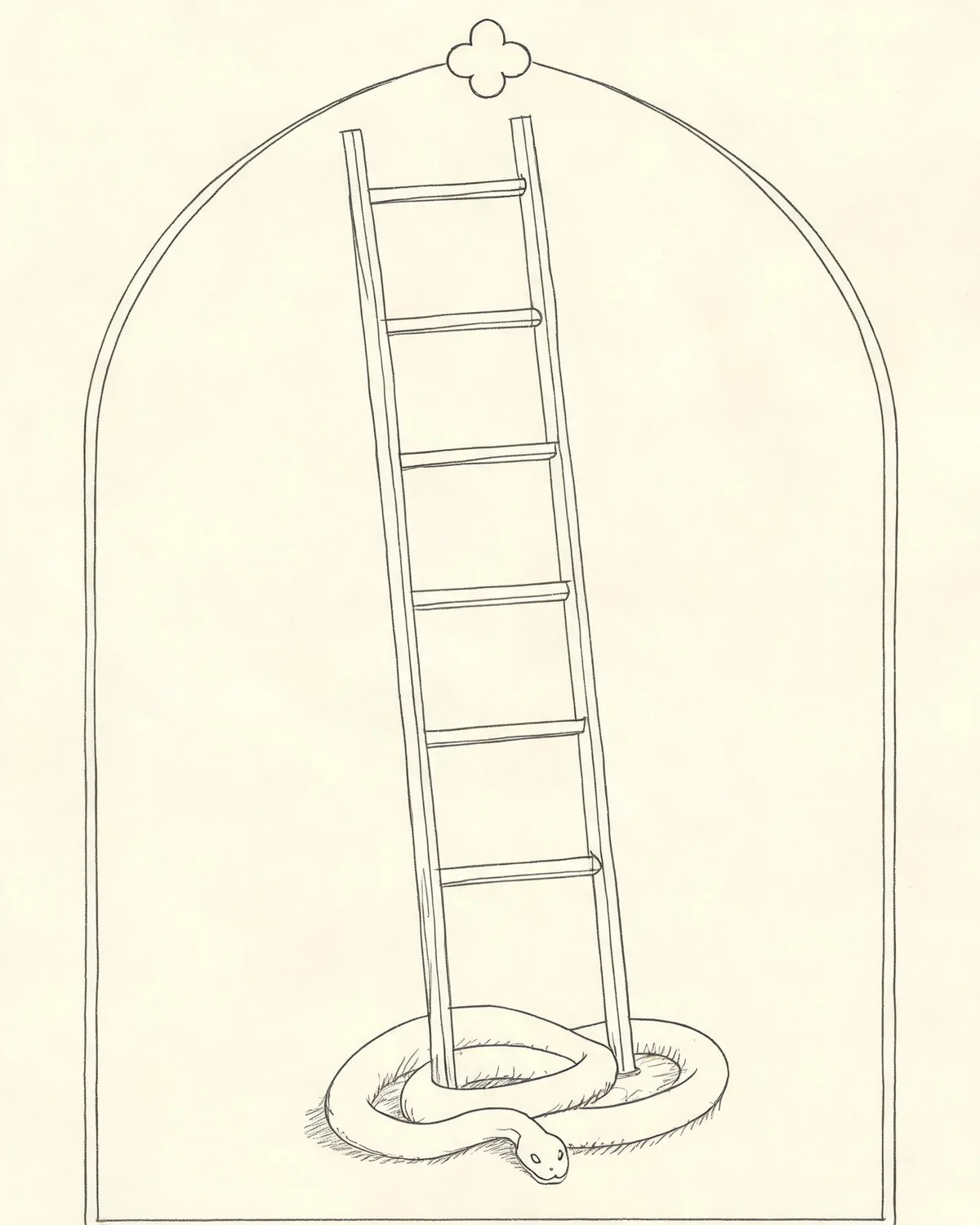
A snake beneath a ladder
One of the earliest recorded Christian dreams belongs here. A young woman in prison saw a narrow ladder reaching to heaven, lined with blades, and a huge serpent lurking at its foot to frighten climbers. She trod on its head as if it were the first rung, and climbed. A snake guarding a way up can stand for the fear that sits at the start of a demanding path.
Picking up a snake unharmed
In biblical imagery, power over serpents and poison was a sign that evil's influence was waning. A dream in which you lift a snake without being bitten draws on that hope. It is not an invitation to test danger, and it is usually read as confidence returning in an area where you once felt exposed, a sign of composure rather than of bravado.
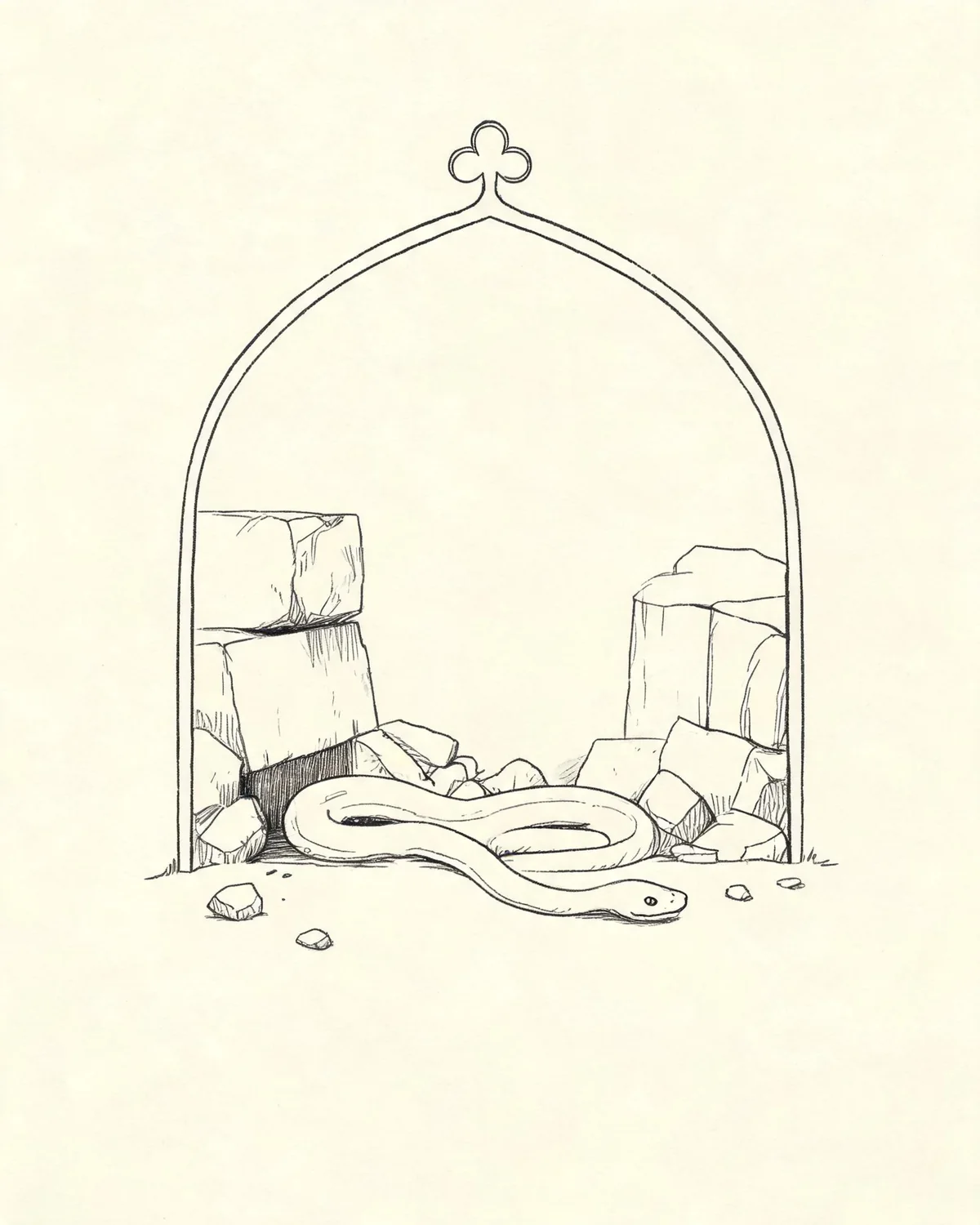
A snake among ruins
Snakes were thought to haunt deserted ruins alongside jackals, owls, ravens and darker presences, which deepened their link with desolation. A snake moving through an empty house, a collapsed church or a derelict street points to a place in your life that has been left untended. The snake is less the cause of the emptiness than the creature that settles where care has stopped.
A great serpent rising from the sea
The sea serpent of biblical poetry is the primordial enemy, a twisting creature of chaos that was subdued long ago yet still figures in a final battle. A huge serpent surfacing from dark water draws on that imagery of chaos too large to manage alone. Christian readers tend to place such a dream within a larger story in which chaos is real but does not have the last word.
A snake that will not be charmed
Biblical writers knew of snakes that defeated the charmer by stopping their ears, and they used them as a picture of people set on harm from the start. A dream in which you plead, soothe or reason with a snake that simply keeps coming may describe a situation where persuasion has reached its limit, and where a firmer boundary is needed.
A child playing near a snake's den
The tradition's final picture of the snake is peace. In the restored creation, a small child plays without fear beside a viper's den, and the serpent's menace is gone. A dream of a child safe beside a snake can draw on that hope of reconciliation. Some Christians read it as reassurance that an old threat is losing its hold.
Common Symbols Paired with Snake
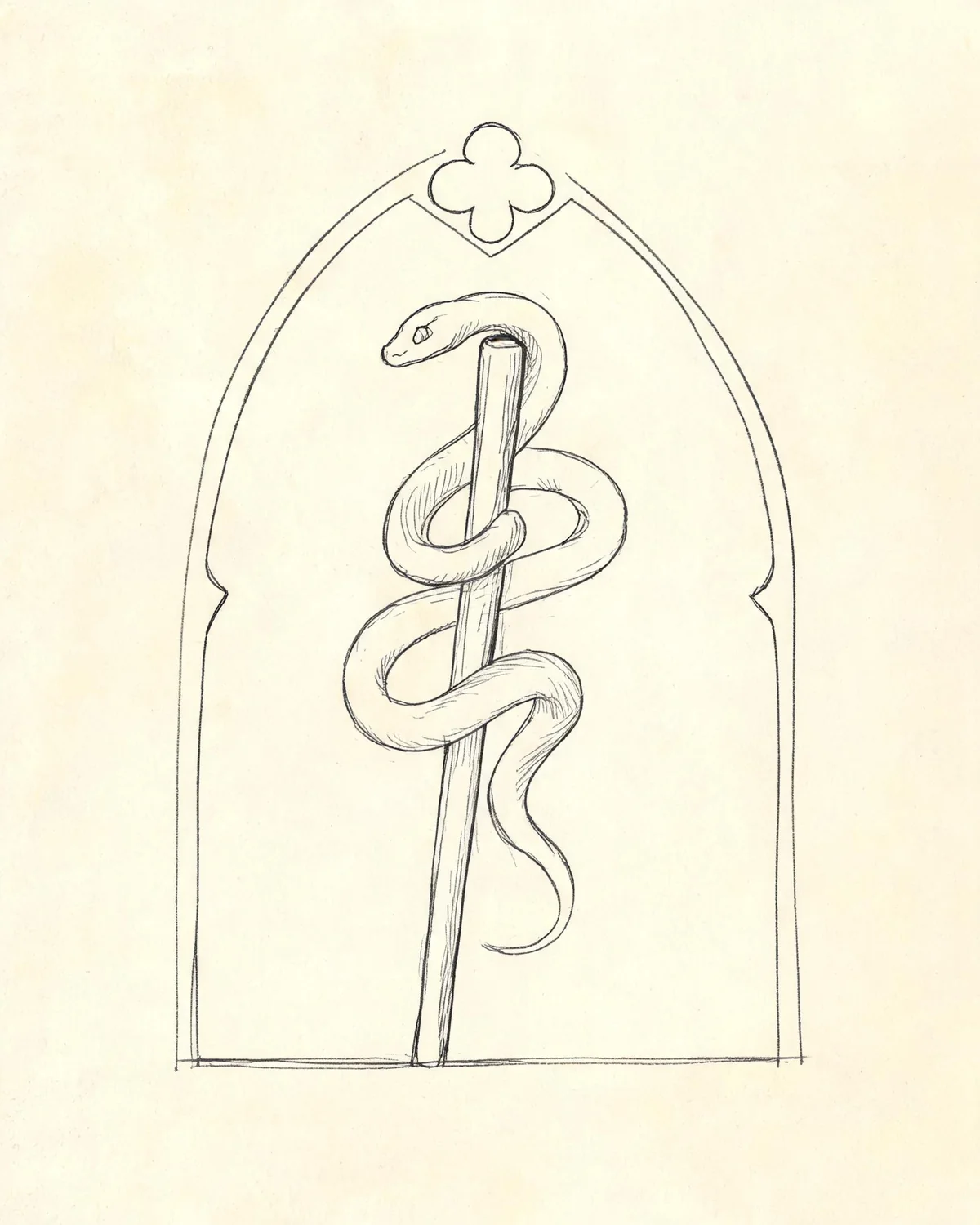
Snake and cross. Christian writers compared Christ to the bronze serpent raised in the wilderness, the image that brought recovery to people who had been bitten. When a snake and a cross appear together, the dream is often read toward rescue and healing rather than danger, with the cross turning the snake's meaning around.
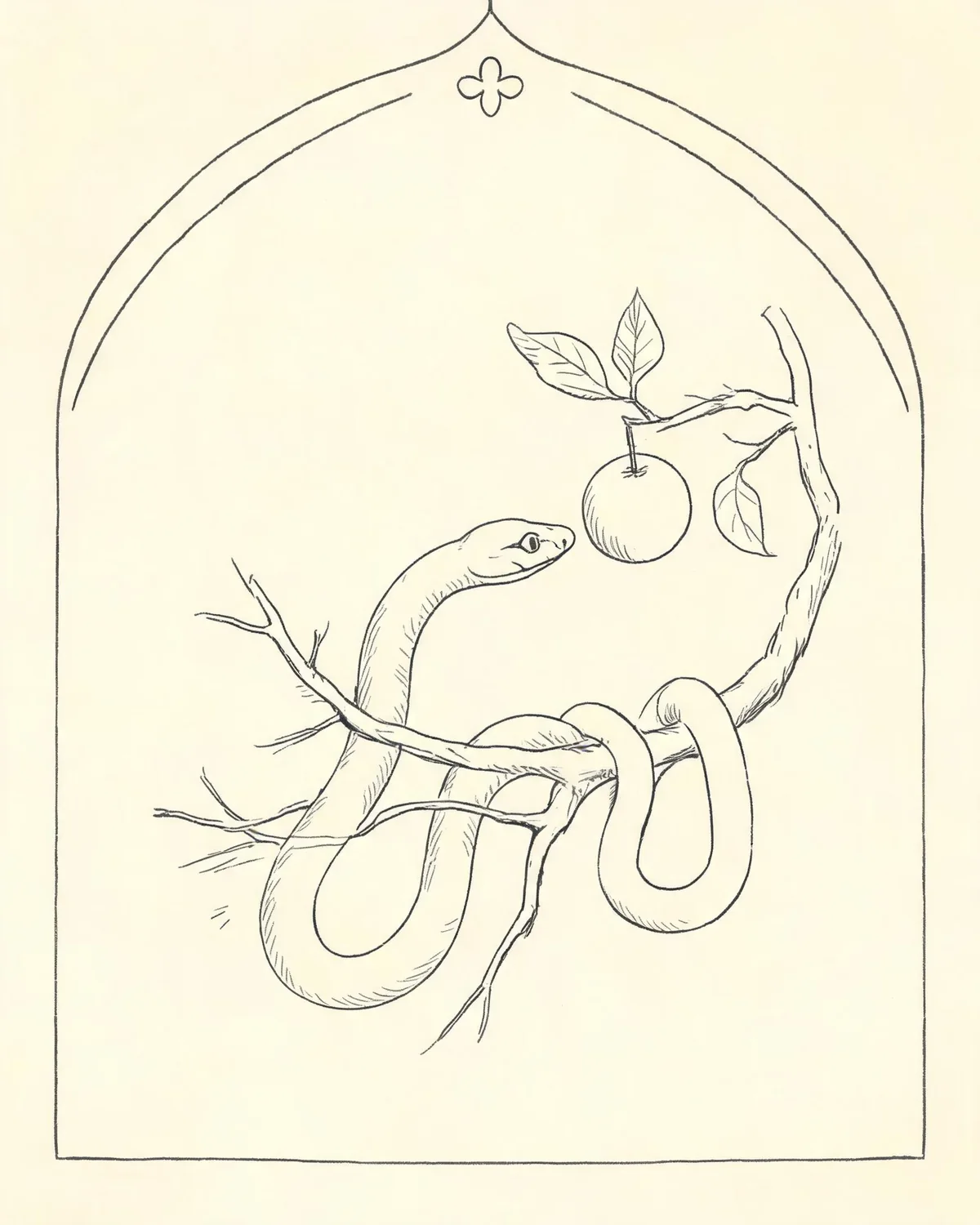
Snake and fruit. The garden scene joins the serpent with forbidden fruit, and the pairing keeps that meaning: a desirable thing offered at the wrong time or by the wrong voice. A snake offering or guarding fruit asks what you are being invited to take, and from whom.
Snake and eggs. The plots of the wicked were compared to snake's eggs that hatch into greater evils. Snake eggs or a nest of hatchlings in a dream can point to small wrongs or resentments that will grow if left alone, and to the advantage of dealing with them early.
Snake and lion. Biblical poetry pairs the two as dangers the faithful will trample underfoot, one open and roaring, one hidden and quiet. A dream with both may be weighing a visible threat against a concealed one, and asking which deserves more of your attention.
How This Tradition Differs from Others
Islamic dream interpreters read the snake mostly as a specific person, frequently an in-law, a grown child or an envious neighbor, and let a person's own conduct reverse a reading. The emphasis falls on the social map of envy and rivalry.
Greek and Roman dream culture placed the serpent near healing. At the great healing sanctuaries, the sacred snakes of the god moved freely through the dormitory where pilgrims slept in hope of a curative dream, and the snake's shed skin stood for a body renewed. Greek traditional dream interpreters also read the same serpent differently for each person who saw it, by character and station, so that one image could mean a runaway, a priest of the mysteries or someone slipping past notice.
In South Asian traditions the snake is often a guardian, with serpent kings and queens watching temple gates, and in philosophy the rope mistaken for a snake becomes the standard picture of illusion.
Christian imagery shares the serpent's ambivalence but sets it inside one story that runs from a garden, through a struggle with deception, to a restored creation. The snake is read within that arc, and each dream is tested against the faith before any meaning is accepted. Where other traditions ask whose envy the snake carries or what illusion it exposes, the Christian question is usually what it is persuading you to do.
What Does Killing a Snake Mean in a Christian Dream?
Killing a snake in a dream draws on one of the oldest promises in the Christian story: an enmity set between the serpent and humanity, ending with the serpent's head struck down. Christian readers have long heard in that promise a picture of evil finally defeated, and a dream of crushing a snake's head takes up that image directly.
The tradition repeats the idea of victory underfoot. Followers were given authority over snakes and scorpions, and early Christians were told that the adversary would soon be crushed beneath their feet. Killing in this frame is less about violence than about refusing a power that had seemed to have the upper hand.
How you killed it still matters. A swift, decisive blow suggests a temptation or influence you are ready to end. A long, desperate struggle may describe how hard it has been to break a habit or leave a relationship. If someone else kills the snake for you, consider who in waking life has helped you stand against something you could not face alone, and whether you have thanked them.
What Does a Green or Black Snake Mean in a Christian Dream?
Green snakes are among the most searched variants, and biblical color imagery gives the color a clear tone. Green is the color of vegetative life: pasture, leaf and flourishing, a sign of provision and favor. A green snake therefore holds a tension. It may point to growth that carries a hidden risk, or to a danger that looks entirely at home among good things, the way the first serpent did in a garden.
Black works differently from what many people expect. Biblical imagery uses black sparingly and mostly as a plain description, and the modern habit of equating black with sin is not part of it; darkness, rather than black, carries the weight of judgment. A black snake is read mainly as a snake, with the color adding a note of foreboding rather than a moral verdict.
White, when it appears, leans toward radiance, festivity and honor. Beyond that, the tradition offers no color code. Colors in biblical writing draw their meaning from nature and custom, so yellow, red or brown snakes are best read through the scene and your feelings rather than a fixed key.

What Does a Snake Bite Mean Biblically in a Dream?
A bite is the snake's most feared act, and biblical writers knew why. Snakes struck from hiding and without warning, so the bite became a metaphor for sudden reversal. A strike out of nowhere, unprovoked and unnatural, also gave the serpent a lasting place in the unseen world in the minds of ancient readers.
Popular belief went further and linked a snakebite with divine judgment, as if the bite exposed hidden guilt. The tradition records that belief among ordinary people, but its larger imagery points elsewhere: the people bitten in the wilderness were given a sign to turn toward, and they recovered. In a Christian reading, being bitten is more a call to turn toward help than a sentence passed on you.
In practice, a dream bite usually asks where something caught you off guard. Notice where the bite landed and what you were doing. A bite on the hand may concern your work or something you reached for; a bite while walking may concern a path you are on. Then ask what remedy the dream itself offered, because in this tradition the story of the bite rarely ends with the wound.
What This Dream Is Not
In this tradition a snake dream is not a forecast of betrayal or harm, and it is not evidence that you are under spiritual attack. The tradition's own scheme places most dreams among ordinary causes before it considers anything else, and it treats claims of a hostile visitation with discernment rather than alarm. It is not a reason to fear a particular person either; the serpent may describe an influence, but naming who carries it is waking work, done slowly and fairly.
Nor is the dream a verdict on your faith or your worth before God. Even the hardest serpent imagery belongs to a story aimed at rescue, and serious spiritual questions are better taken to a pastor, priest or trusted spiritual director than settled by a single night's images.
FAQ
Is a snake in a dream always the devil in Christian belief?
No. The serpent is often the adversary in biblical imagery, but the tradition also links it with wisdom, beauty and even healing. The scene, the snake's behavior and your own response decide which side is showing.
Is dreaming of snakes a spiritual attack?
Christian teaching does recognize misleading dreams, but it lists ordinary causes first, from what you ate to what you were worrying about. Discernment, prayer and a trusted adviser are the tradition's response, rather than assuming an attack.
What does a dead snake mean in a Christian dream?
Finding a snake already dead can be read as a threat that has lost its force without your effort. Some Christians see in it a picture of grace: a struggle settled before you had to fight it.
What does a snake chasing you mean biblically?
Biblical writers noticed how a snake's slow approach seemed to hold its prey still. A chasing snake often reflects a pressure you feel unable to escape, and the more useful question is what keeps you watching instead of moving away.
What does a snake's tongue mean in a dream?
Biblical poetry likens poisonous speech to a serpent's venom. A flickering snake tongue in a dream often points to speech: gossip, flattery or a sharp remark, whether it came from someone else or from you.
Can a snake dream be from God in Christianity?
The tradition allows that some dreams carry revelation, but it never assumes so. Any message must agree with the faith and the teaching of the church, and most snake dreams are first read as ordinary or psychological.
Why do Christians dream about snakes so often?
Snakes unsettle people almost everywhere, and Christian imagery is saturated with serpents, from the garden onward. Dreams draw on what we fear and what we have absorbed, so the image surfaces easily, especially during temptation or conflict.
What does a snake in a tree mean in a Christian dream?
A snake among branches recalls the tree at the center of the garden story, where temptation met desire. Many Christian readers take it as a question about something attractive within reach that you sense you should not take.
How to Use These Readings Today
First, name the voice. Write down what the snake did and, if it spoke or enticed, what it seemed to offer. Then set that offer beside your life this week: a shortcut, a flattering opportunity, a resentment you have been feeding. The tradition's main question is whose influence is at work.
Second, apply the old test. Ask whether the direction the dream points you in fits the faith you hold and the person you are trying to become. If it does not, the dream may still be useful, as a picture of what you are resisting.
Third, take one small step. Bring the dream into prayer, mention it to someone you trust, or deal with one small wrong before it hatches into a larger one. Keep a note for a week and see whether the snake returns, and what has changed in the scene or in you if it does.